
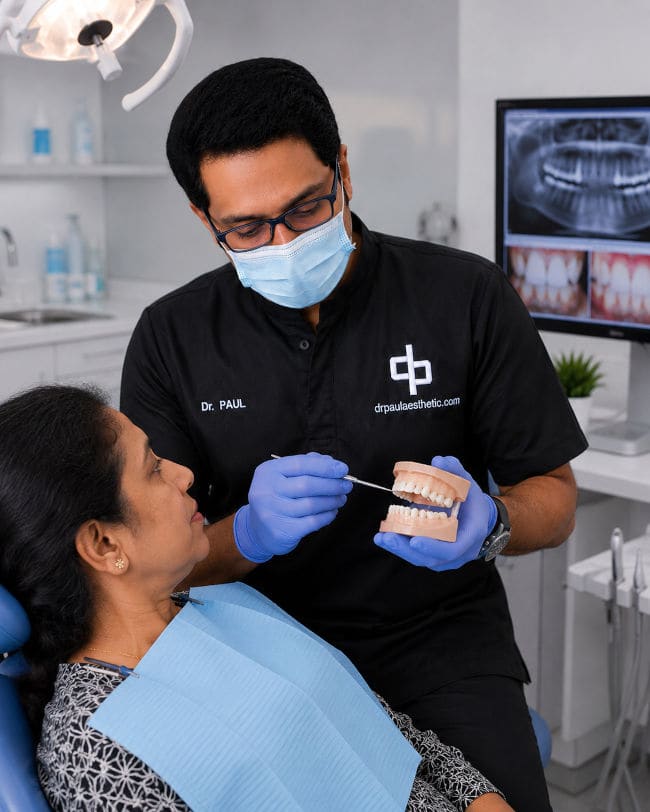
A dental bridge “bridges” a gap left by a missing tooth. A conventional bridge uses crowns on the neighbouring teeth to support a false tooth (a pontic) between them. Adhesive or resin-bonded bridges use a thin wing bonded to the back of an adjacent tooth and need much less preparation.
Bridges are fixed in place — they are not removed for cleaning — and can be a practical alternative to implants for some patients.
Who this treatment may suit
- One or two missing teeth with healthy supporting teeth next to the gap
- Neighbouring teeth that already need crowns
- Patients for whom implants are not suitable or not preferred
Common concerns it addresses
- A visible gap in the smile
- Difficulty chewing on one side
- Teeth drifting or tilting into a space
Suitability can only be confirmed after a clinical examination.
How dental bridges works
The supporting teeth are assessed carefully, because a bridge depends on them. For a conventional bridge they are prepared similarly to crowns; for an adhesive bridge, minimal or no preparation may be needed.
After a scan or impression, a laboratory makes the bridge. It is tried in, adjusted and cemented.
Consultation and assessment
At the consultation, Dr. Paul will compare bridges with implants and dentures for your particular gap, explaining the effect each has on neighbouring teeth, the cleaning involved, and expected maintenance.
Treatment stages
- 1
Assessment
Health of supporting teeth, gums and bone is checked.
- 2
Preparation
Supporting teeth are prepared and scanned; a temporary bridge may be fitted.
- 3
Fit
The bridge is checked for bite, appearance and cleanability, then fixed.
Potential benefits
- Fixed, non-removable replacement
- Usually completed within a few weeks
- No surgery required
Risks and limitations
- Conventional bridges involve reshaping neighbouring teeth
- If one supporting tooth fails, the whole bridge may need replacing
- Cleaning under the false tooth requires special floss or brushes
- Bone under the gap continues to shrink over time
Results vary between individuals and cannot be guaranteed. Your dentist will discuss the risks that apply to you.
Alternative options
- Dental implants
- Removable partial dentures
- Leaving the gap and monitoring, when appropriate
Aftercare
- Use superfloss, a water flosser or interdental brushes to clean under the pontic daily
- Attend regular reviews so supporting teeth can be checked
Frequently asked questions
Is a bridge better than an implant?
Neither is better for everyone. Implants avoid preparing neighbouring teeth but require surgery and adequate bone; bridges are quicker and non-surgical but depend on the supporting teeth.
Can a bridge be attached to implants?
Yes. Implant-supported bridges are used to replace several missing teeth without involving natural teeth.
Where this treatment is available
Dr. Paul sees patients at Lakeshore Aesthetic & Wellness Centre (Al Nahda), Taif Medical Centre (Deira), Dr. Paul Speciality Dental Clinic (Chungam Junction). Please check which location offers this treatment when you contact the clinic.
Further reading
This page is general information and does not replace an individual consultation.