
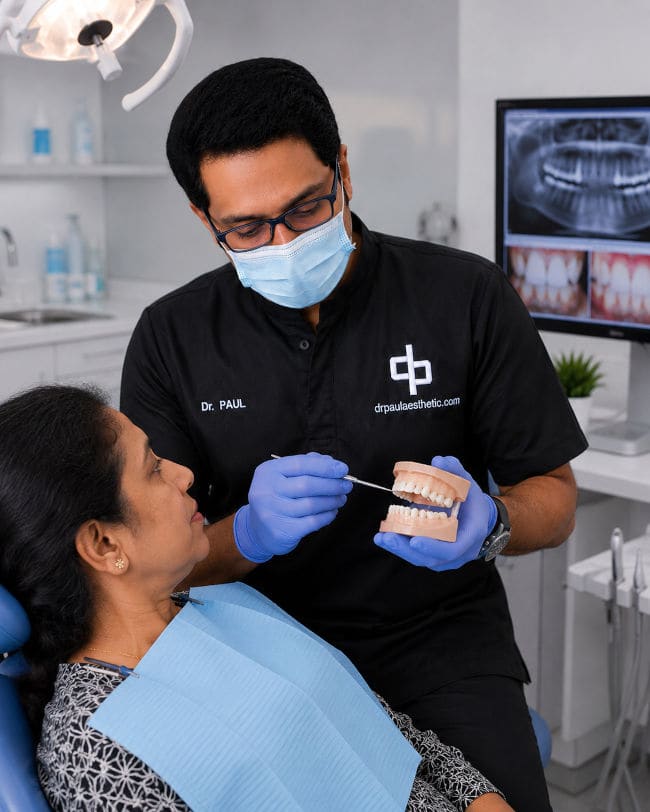
A dental implant is a small screw-shaped post, usually made of titanium, placed into the jawbone where a tooth is missing. Once it has integrated with the bone, it supports a crown, bridge or denture.
Implant dentistry is one of Dr. Paul’s focus areas; he holds a Fellowship in Oral Implantology. Careful assessment of bone, gums and general health is essential before implant treatment.
Who this treatment may suit
- Adults with one or more missing teeth and healthy gums
- Patients with adequate bone, or who are suitable for bone grafting
- Denture wearers who want more stability
Common concerns it addresses
- A gap after extraction
- Loose or uncomfortable dentures
- Difficulty chewing
Suitability can only be confirmed after a clinical examination.
How dental implants works
Treatment is planned from a clinical examination and 3D imaging (CBCT) to assess bone volume and nearby structures. The implant is placed under local anaesthetic. A healing period — often a few months — allows the bone to bond to the implant (osseointegration).
Once integrated, an abutment and the final crown or bridge are fitted. In selected cases, a temporary tooth can be attached sooner.
Consultation and assessment
At the consultation, Dr. Paul will review your medical history (including smoking, diabetes and medications that affect bone), examine the area, and explain whether implants, bridges or dentures are best suited to you.
Treatment stages
- 1
Assessment and 3D imaging
Bone, gum and medical assessment.
- 2
Planning
Implant position planned for the final tooth.
- 3
Placement
Implant placed under local anaesthetic; grafting if needed.
- 4
Healing
Osseointegration period, with temporary teeth if appropriate.
- 5
Restoration
Final crown, bridge or denture attached.
Potential benefits
- Does not involve preparing neighbouring teeth
- Stable chewing function
- Helps preserve bone where the implant is placed
Risks and limitations
- Surgical risks including pain, swelling, bleeding and infection
- Implant failure to integrate, more likely in smokers and people with uncontrolled diabetes
- Nerve or sinus involvement if anatomy is not carefully assessed
- Peri-implantitis (gum and bone inflammation around implants) over time
- Restorations on implants may need maintenance or replacement
Results vary between individuals and cannot be guaranteed. Your dentist will discuss the risks that apply to you.
Alternative options
- Dental bridges
- Removable partial or complete dentures
- Leaving the gap where appropriate
Aftercare
- Clean around implants as carefully as natural teeth, using interdental brushes
- Do not smoke
- Attend regular reviews and professional cleaning
Frequently asked questions
Are dental implants painful?
Placement is done under local anaesthetic. Discomfort afterwards is usually managed with standard pain relief.
How long does implant treatment take?
Commonly three to six months from placement to final tooth, longer if bone grafting is needed.
Do implants last forever?
Implants can last many years with good care, but they need maintenance and are not guaranteed for life.
Where this treatment is available
Dr. Paul sees patients at Lakeshore Aesthetic & Wellness Centre (Al Nahda), Taif Medical Centre (Deira), Dr. Paul Speciality Dental Clinic (Chungam Junction). Please check which location offers this treatment when you contact the clinic.
Further reading
This page is general information and does not replace an individual consultation.